When comparing WPC wall cladding, many buyers naturally associate greater weight with better quality. A thick, heavy PE WPC panel often feels stronger than a lightweight PVC WPC panel.
But when the lighter PVC WPC panel also comes with a higher price, buyers may wonder: Why should a panel made with less material cost more?
The answer lies in the differences between the two material systems.
A heavier WPC panel is not necessarily stronger, and a lighter panel is not necessarily cheaper to manufacture. Material formulation, foam density, profile design, and manufacturing control all affect the final product.
For WPC wholesalers, importers, and distributors, understanding these factors is essential when comparing products from different manufacturers.
Key Takeaways
Heavier WPC wall panels are not automatically stronger or better in quality.
PE WPC and PVC WPC differ in material composition, density, and manufacturing methods.
Lightweight PVC WPC requires careful formulation and foam control to maintain mechanical performance.
Higher PVC resin content can increase formulation costs, even when the finished panel weighs less.
Verified mechanical test results provide a better basis for evaluating quality than weight alone.
1. Does a Heavier WPC Wall Panel Mean Better Quality?
A heavier wall panel often feels more solid when handled. This impression is understandable, especially when comparing a dense PE WPC profile with a lightweight PVC WPC profile.
However, panel weight alone does not determine mechanical strength.
Weight depends on material density, profile dimensions, and cross-sectional structure. Mechanical performance also depends on the polymer type, filler content, internal structure, and manufacturing quality.
PE WPC commonly uses polyethylene as its polymer base. PE contributes flexibility and toughness, which can be beneficial under impact or deformation.
PVC WPC uses a different polymer system. Rigid PVC contributes stiffness, while impact modifiers and other additives help achieve the required mechanical performance.
Both materials have their own characteristics.
A heavier PE WPC panel may perform well under certain loading conditions, but this does not automatically mean it is stronger than every lighter PVC WPC panel.
Comparing mechanical test results is more reliable than judging quality by weight or appearance.
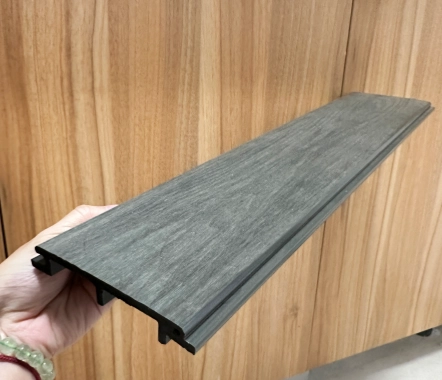
2. Why Are PVC WPC Wall Panels Lighter Than PE WPC Panels?
One important difference is how the materials are manufactured.
Many traditional PE WPC wall panels use non-foamed composite materials. Their weight comes from the combined density of polyethylene, wood flour, mineral fillers, and the profile structure.
PVC WPC wall panels can use foaming technology to reduce material density.
During extrusion, small gas cells form inside the PVC composite. These cells reduce the amount of solid material required to occupy a given volume.
This allows manufacturers to produce lighter profiles without relying solely on thinner walls or larger hollow sections.
A Practical Example: MATECO WPC Q155CD
MATECO WPC Q155CD PVC WPC wall panel has the following specifications:
| Specification | Q155CD |
|---|---|
| Weight per linear meter | 0.62 kg/m |
| Material density | 0.80 g/cm³ |
| Material type | PVC WPC |
The density of 0.80 g/cm³ is measured from the profile material itself, excluding the hollow spaces.
These specifications demonstrate how foamed material density and profile design contribute to the finished panel's relatively low weight.
However, lightweight construction does not automatically guarantee good mechanical performance. That depends on the formulation, foam structure, and manufacturing process.
3. Why Does Lightweight PVC WPC Require Careful Formulation?
Producing a lightweight PVC WPC wall panel involves more than reducing material consumption.
The manufacturer must balance PVC resin, fillers, additives, and foam structure to achieve the intended performance.
PVC Resin: Holding the Composite Together
PVC resin forms the continuous polymer structure that surrounds wood flour, calcium carbonate, and other fillers.
This polymer structure helps hold the ingredients together and transfer stress throughout the composite.
Reducing PVC content and replacing it with lower-cost fillers may reduce raw material expenses.
However, excessive filler loading can interfere with the composite structure and increase the risk of brittle fracture, especially when the formulation is not properly balanced.
This does not mean that more PVC always produces a stronger panel. Processing conditions, impact modifiers, and filler characteristics also influence mechanical performance.
Calcium Carbonate: Balancing Cost and Performance
Calcium carbonate is commonly used in PVC WPC formulations because it is generally less expensive than PVC resin.
At appropriate levels, it can contribute to material stiffness and processing behavior.
But increasing calcium carbonate content simply to reduce costs can create problems.
If too much filler is added without sufficient polymer and proper formulation adjustments, the panel may become more susceptible to cracking or impact damage.
A good formulation therefore requires a balance between resin content, filler loading, and the required product performance.
Foam Control: Maintaining Performance at Lower Density
For foamed PVC WPC, reducing density introduces another challenge.
The manufacturer must control the formation and distribution of gas cells inside the material.
Small, consistent cells help create a more uniform foam structure. If the cells become too large, merge, or collapse, internal defects may develop and affect mechanical performance.
Foam regulators, processing aids, and extrusion conditions all influence this process.
As the target density decreases, maintaining a stable foam structure and the required mechanical properties can become more demanding.
The challenge is not simply making a WPC panel lighter. It is reducing weight while maintaining the performance required for its intended use.
4. Why Can a Lighter PVC WPC Wall Panel Cost More?
A common assumption is that lighter products should be cheaper because they contain less material.
However, material weight and formulation cost are not the same thing.
At MATECO WPC, we use a relatively high proportion of PVC resin in our PVC WPC formulation.
PVC provides the continuous polymer structure that helps bind fillers together and supports the composite's mechanical properties.
Using a relatively high PVC proportion is part of our approach to maintaining the intended product performance.
However, PVC resin is also a significant cost component in our formulation.
Compared with a formulation that replaces more PVC with lower-cost fillers, this approach can increase raw material costs.
Foaming technology adds another consideration.
Producing lower-density PVC WPC requires appropriate foam regulators, processing additives, and controlled extrusion conditions to help maintain a consistent internal structure.
If foam formation is not properly controlled, defects and inconsistent product quality may increase manufacturing losses.
Therefore, even though a foamed PVC WPC panel uses less material per unit volume, its formulation and manufacturing requirements may still result in a higher production cost.
This does not mean every PVC WPC panel costs more than PE WPC. The actual difference depends on raw material prices, formulation, profile design, and production efficiency.
A lighter panel may contain less material by weight, but that material can be more expensive to formulate and manufacture.
5. How Should Wholesalers Compare PVC and PE WPC Wall Panels?
For wholesalers and importers, the most important question is not simply which panel is heavier.
It is whether the panel provides the mechanical performance, dimensional consistency, and cost structure required for its intended market.
Look at Actual Mechanical Test Results
MATECO WPC Q155CD provides an example of why mechanical testing matters.
In addition to its weight of 0.62 kg/m and material density of 0.80 g/cm³, Q155CD has been tested according to ASTM D6109, a standard for evaluating the flexural properties of manufactured plastic lumber and related composite products.
The reported results are:
| Mechanical Property | Test Result | Test Standard |
|---|---|---|
| Flexural Strength | 30.58 MPa | ASTM D6109 |
| Modulus of Elasticity | 2,204 MPa | ASTM D6109 |
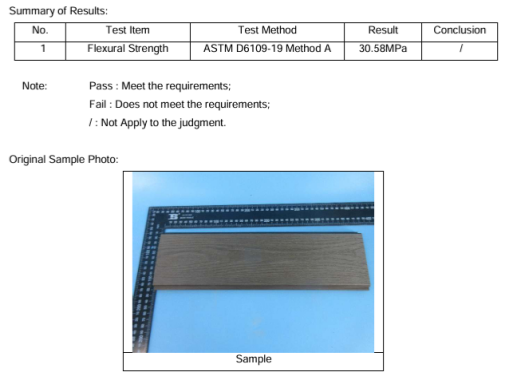
Flexural strength describes the product's resistance to bending stress under the specified test conditions.
Modulus of elasticity indicates its stiffness during bending.
These results provide measurable information about Q155CD's bending performance rather than relying only on how heavy the panel feels.
They do not establish that Q155CD is stronger than a heavier PE WPC panel. A direct comparison would require corresponding test data under comparable conditions.
Impact resistance would also need to be evaluated separately.
Compare More Than Weight and Price
When comparing WPC wall panels from different suppliers, consider the following factors:
| Comparison Factor | Why It Matters |
|---|---|
| Weight per meter | Shows the finished profile's weight |
| Material density | Helps explain differences in material composition and structure |
| Profile design | Influences structural behavior and material consumption |
| Flexural performance | Provides measurable information about bending strength and stiffness |
| Impact resistance | Helps assess resistance to impact damage |
| Dimensional stability | Indicates behavior under temperature changes |
| Batch consistency | Supports reliable specifications across bulk orders |
| Cost per square meter | Allows a more meaningful comparison of coverage costs |
A heavier panel may be suitable for certain applications, while a lighter panel may offer advantages in handling and freight weight.
Neither should be considered better based on weight alone.
For distributors and importers, verified product specifications and performance data provide a more reliable basis for comparing suppliers.
Conclusion
A heavier WPC wall panel is not automatically stronger, and a lighter PVC WPC panel is not necessarily cheaper to produce.
PE WPC and PVC WPC use different polymer systems, formulations, and manufacturing methods.
For lightweight foamed PVC WPC, maintaining mechanical performance requires a suitable balance of PVC resin, fillers, additives, and foam control.
At MATECO WPC, our relatively high PVC resin proportion reflects our formulation approach, while Q155CD's ASTM D6109 results provide measurable information about its bending performance.
For wholesalers, importers, and distributors, weight should be one comparison factor—not the final measure of WPC wall panel quality or value.